How AI Can Optimize Operations Without Adding Extra Staffs
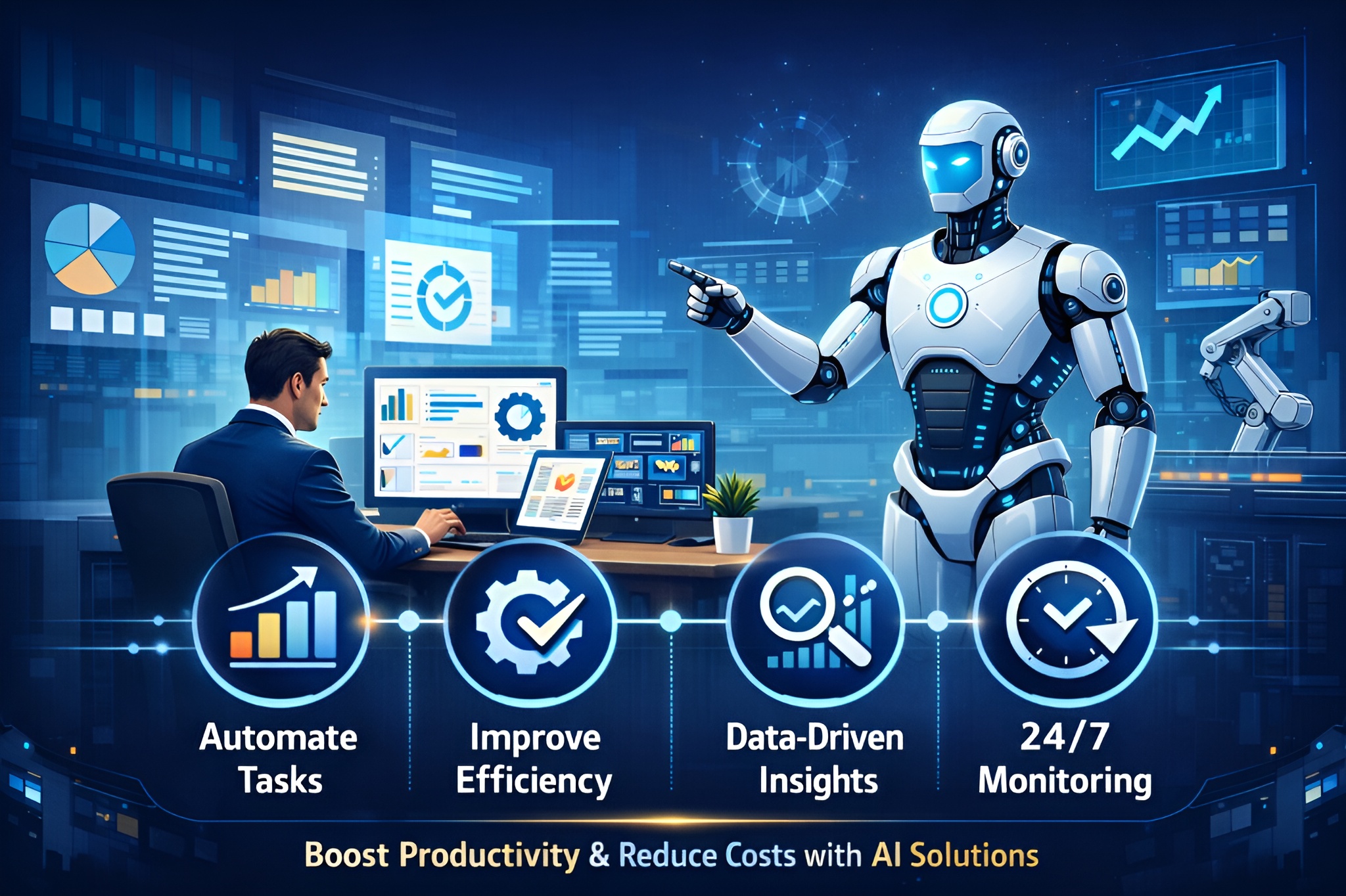
Table of Contents
“Discover how AI can streamline business operations and boost productivity without increasing staffs. This guide explores automation of administrative tasks, customer support, supply chains, workflow orchestration, and intelligent decision-making, showing how organizations can scale smarter in 2026.”
Introduction
Most businesses today face the same challenge: demand keeps growing, costs keep rising, but hiring more people is expensive, slow, and risky. In 2026, AI has become one of the most powerful ways to scale operations without scaling headcount.
The goal is simple: help your existing team do more — more output, better quality, faster speed, and higher consistency — while improving accuracy, customer satisfaction, and profitability.
This is no longer experimental. Companies of all sizes are already using AI to automate routine work, make smarter decisions, and free people for high-value tasks like strategy, creativity, and relationship building.
Here’s how AI is transforming operations in 2026 — without requiring you to hire extra staff.
1. Automate Repetitive & Time-Consuming Tasks
AI excels at anything repetitive, predictable, or rule-based — the kind of work that quietly drains energy from good people.
Practical examples:
- Invoice processing & reconciliation — AI reads PDFs/emails, extracts data, matches payments, flags mismatches.
- Customer support triage — Chatbots and voice agents resolve 60–80% of common questions (balance checks, order status, FAQs).
- Data entry & form population — Pull information from messages, photos, or forms → auto-fill CRM, ERP, or spreadsheets.
- Expense approvals — Scan receipts → categorize → approve low-risk ones instantly.
Outcome: One person can now comfortably manage what used to require 3–5 people. Time saved: 20–40 hours per week per process.
2. Intelligent Routing & Smart Prioritization
AI decides what should happen first and who (or what) should handle it — reducing delays and wasted effort.
Real-world applications:
- Logistics & delivery — Reroute drivers in real-time based on traffic, fuel prices, order urgency, and vehicle load.
- Support ticket routing — Send each query to the best agent or AI based on topic, language, urgency, and history.
- Sales lead prioritization — Surface the hottest leads today based on behavior and CRM signals.
- Field service scheduling — Optimize technician routes and parts stocking automatically.
Outcome: 30–50% faster resolution times, higher first-contact success rates, and much happier customers — all with the same team size.
3. Predict Problems Before They Happen
Instead of reacting to breakdowns or stockouts, AI spots patterns early and prevents issues.
Common wins:
- Equipment maintenance — Predict machine failures from sensor data before they cause downtime.
- Inventory forecasting — Anticipate demand spikes (seasonal trends, promotions) and auto-reorder.
- Fraud & anomaly detection — Catch suspicious activity in real-time without manual checks.
- App & server health — Predict slowdowns or crashes and auto-scale or restart services.
Outcome: 50–80% less unplanned downtime, fewer emergency fixes, and no need for extra coverage.
4. Give Your Team Supercharged Decision Support
AI acts like a high-speed co-pilot — delivering better information faster so your people make smarter choices.
Examples:
- Credit & loan decisions — Evaluate risk in seconds using available data sources.
- Dynamic pricing — Adjust prices for e-commerce, transport, or services based on demand, competition, and time.
- Cross-sell & up-sell suggestions — Recommend relevant products during checkout or support conversations.
- Shift & resource scheduling — Predict peak times and suggest optimal patterns.
Outcome: Higher revenue per customer, lower risk, and better resource use — without hiring extra analysts or planners.
5. Build Systems That Keep Getting Better
The most powerful level: AI that learns and improves itself over time.
- Auto-update fraud models when new patterns appear
- Run A/B tests on pricing, messaging, or flows automatically
- Continuously optimize routes, inventory, or workflows for lower cost and faster delivery
- Detect shifts in customer behavior → refresh recommendations instantly
Outcome: Your operations improve week after week — without adding data scientists or analysts.
Quick Comparison: Traditional vs. AI-Optimized Operations (2026)
| Area | Traditional Way | AI-Optimized (2026) | Typical Benefit |
|---|---|---|---|
| Invoice processing | Manual checking by 3–5 people | 80–90% automated + 1 overseer | –70–80% time / effort |
| Customer support | Long queues, large team | 60–80% resolved by AI + smaller team | –50–70% agents needed |
| Logistics routing | Manual dispatcher + spreadsheets | Real-time AI rerouting | 1 person handles 3–5× volume |
| Fraud detection | Manual review team | Real-time AI scoring + minimal review | –60–80% reviewers |
| Decision-making | Spreadsheets + meetings | AI-powered recommendations | Faster, better decisions |
How to Start Small & See Real Results
-
Pick one painful, repetitive process
Invoice handling, customer onboarding, support triage, or expense approvals are excellent starting points. -
Begin with low-code / no-code tools
- Make.com + OpenAI
- Zapier + Claude / GPT
- n8n (open-source) + local models
- Gumloop, Voiceflow, or Bubble for agent-like flows
-
Build in safety from day one
- Require human approval for high-value actions
- Keep full audit logs
- Set sensible limits where needed
-
Measure real outcomes
Time saved, errors reduced, revenue per employee, customer satisfaction — not just “tasks automated” -
Scale thoughtfully
Master one process → expand to three → ten. Add headcount only when AI truly hits its limit.
Final Thought
In 2026, winning companies aren’t the ones with the biggest teams — they’re the ones with the smartest leverage.
AI doesn’t replace people. It replaces unnecessary work, letting your existing team focus on creativity, relationships, strategy, and growth.
The real competitive advantage today is clear: do more, faster, cheaper, and better — with the people you already have.
Which operation in your business do you think could be transformed first? Drop it in the comments — I’d love to outline a quick AI-first approach for you.
Reference
References & Further Reading
- Gartner — Agentic AI in Operations 2026
- McKinsey — AI-Powered Operations Report 2026
- UiPath — State of Automation 2026
- Deloitte — AI in the Enterprise 2026
- Harvard Business Review — The Future of Work with AI
Recommended Insights
Continue your journey