Integrating AI with your Existing Software stack
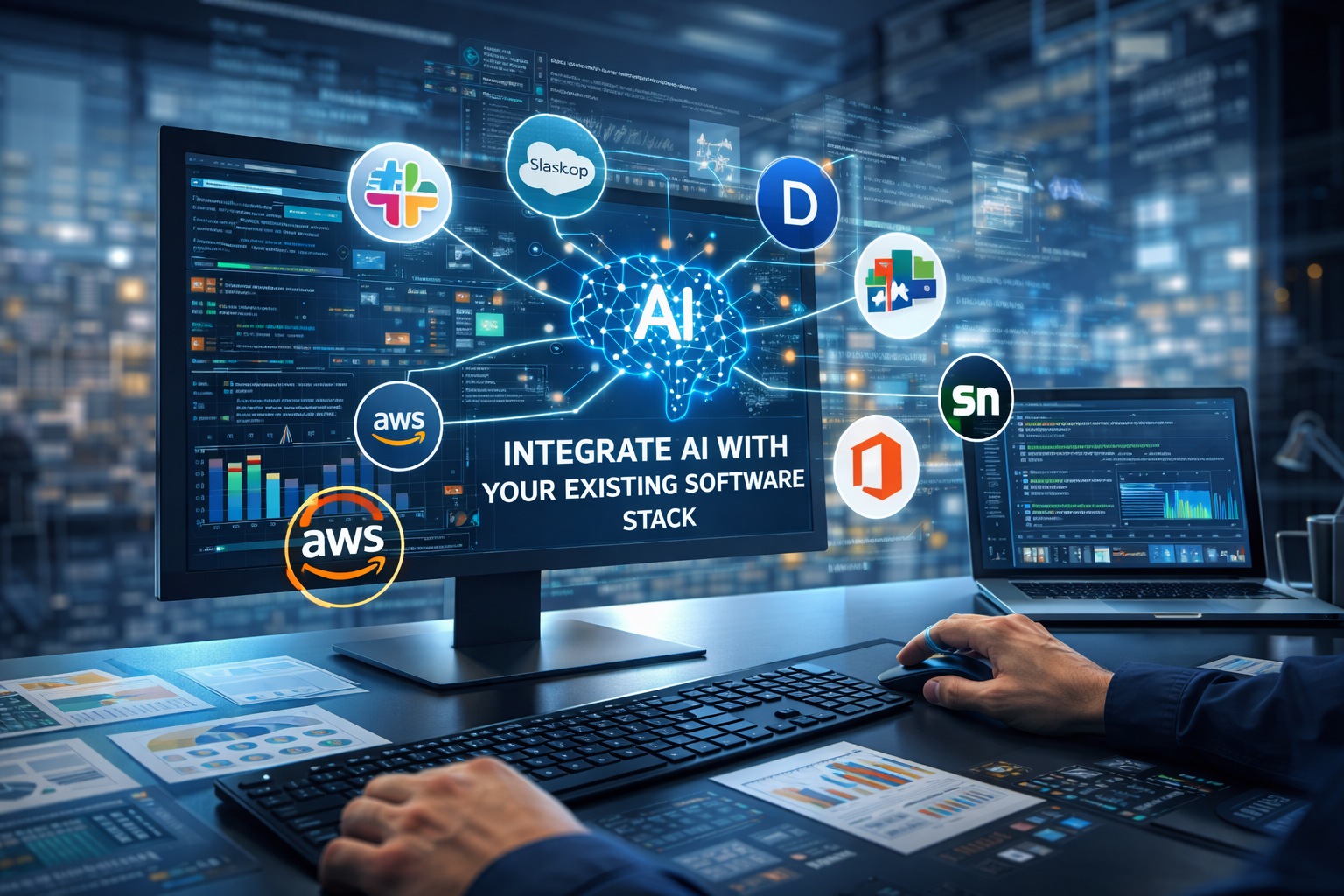
Table of Contents
“Learn how to integrate AI and machine learning into your existing software stack in 2026. This guide covers identifying high-impact use cases, choosing the right tools, deployment strategies, building modular AI services, ensuring data quality, and implementing monitoring for scalable and production-ready systems.”
Introduction
Artificial intelligence and machine learning are no longer futuristic concepts—they are practical tools for enhancing software systems. In 2026, businesses and developers are integrating AI/ML into existing software to automate workflows, improve decision-making, and deliver smarter user experiences.
This guide explains how to approach AI/ML integration in a structured way, helping you avoid common pitfalls and design scalable, maintainable systems.
Why Integrate AI/ML?
Adding AI/ML to your software stack can:
- Automate repetitive tasks and workflows
- Improve predictions and personalization
- Enhance analytics and reporting
- Enable smarter decision-making in real-time
- Provide competitive advantages through data-driven insights
Step 1: Identify High-Impact Use Cases
Focus on areas where AI/ML adds measurable value. Common examples:
- Customer support automation (chatbots, ticket routing)
- Fraud detection or anomaly monitoring
- Predictive maintenance for hardware or infrastructure
- Recommendation engines for products or content
- Workflow optimization and task prioritization
Step 2: Understand Your Current Stack
Before adding AI/ML, map your current architecture:
- Frontend: Web, mobile, or internal dashboards
- Backend: APIs, business logic, and orchestration services
- Data Layer: Databases, warehouses, and streaming systems
- Infrastructure: Cloud, edge devices, and CI/CD pipelines
This will help you determine where AI/ML components fit naturally.
Step 3: Choose the Right AI/ML Tools
Pick tools that match your technical requirements, team skillset, and scale:
- Model APIs: OpenAI GPT-4o, Claude, Google Gemini
- Deep Learning Frameworks: TensorFlow, PyTorch
- Data Preparation: Pandas, NumPy, Dask
- Deployment: Docker, Kubernetes, ONNX, TorchServe
- Automation Agents: LangGraph, AutoGen
Step 4: Decide on Deployment Strategy
AI/ML can run in several ways:
- Cloud-Based: Quick to deploy, ideal for large models
- Edge/On-Premise: Low-latency and privacy-sensitive use cases
- Hybrid: Critical tasks run locally, complex tasks run in the cloud
Step 5: Build an AI/ML Service Layer
Instead of embedding AI directly in the backend:
- Expose AI/ML as modular services or microservices
- Handle model inference, validation, and logging separately
- Keep services independent for easier scaling and updates
Step 6: Ensure Data Quality and Feedback Loops
- Clean and preprocess your datasets
- Version and track data and model outputs
- Monitor AI/ML performance and adjust models over time
- Collect user feedback to improve accuracy continuously
Step 7: Implement Monitoring and Governance
- Track performance metrics (latency, accuracy, errors)
- Monitor drift in model predictions over time
- Ensure compliance with privacy and security regulations
- Audit AI/ML decisions to maintain trust and reliability
Example Integration Scenario
A fintech application might integrate AI/ML like this:
- Frontend: React dashboard for users
- Backend: FastAPI service for business logic
- AI/ML Layer: Fraud detection model running on PyTorch, accessed via API
- Database: PostgreSQL + Redis for caching
- Monitoring: Prometheus + Grafana for model performance and alerts
This setup allows scalable, modular AI/ML integration without disrupting existing services.
Common Pitfalls to Avoid
- Treating AI/ML as a plug-and-play feature
- Ignoring data preprocessing and quality checks
- Overcomplicating models instead of optimizing performance
- Skipping testing and validation of AI outputs
- Not planning for long-term model maintenance
Conclusion
Integrating AI/ML into your software stack is not just a technical upgrade—it is a strategic move. When done thoughtfully, AI/ML enhances existing applications, drives automation, improves user experience, and provides actionable insights.
In 2026, the best integrations are modular, data-driven, and scalable, allowing organizations to adapt quickly as AI/ML technology evolves.
Recommended Insights
Continue your journey