Top Machine Learning Libraries for Beginners (2026 Guide)
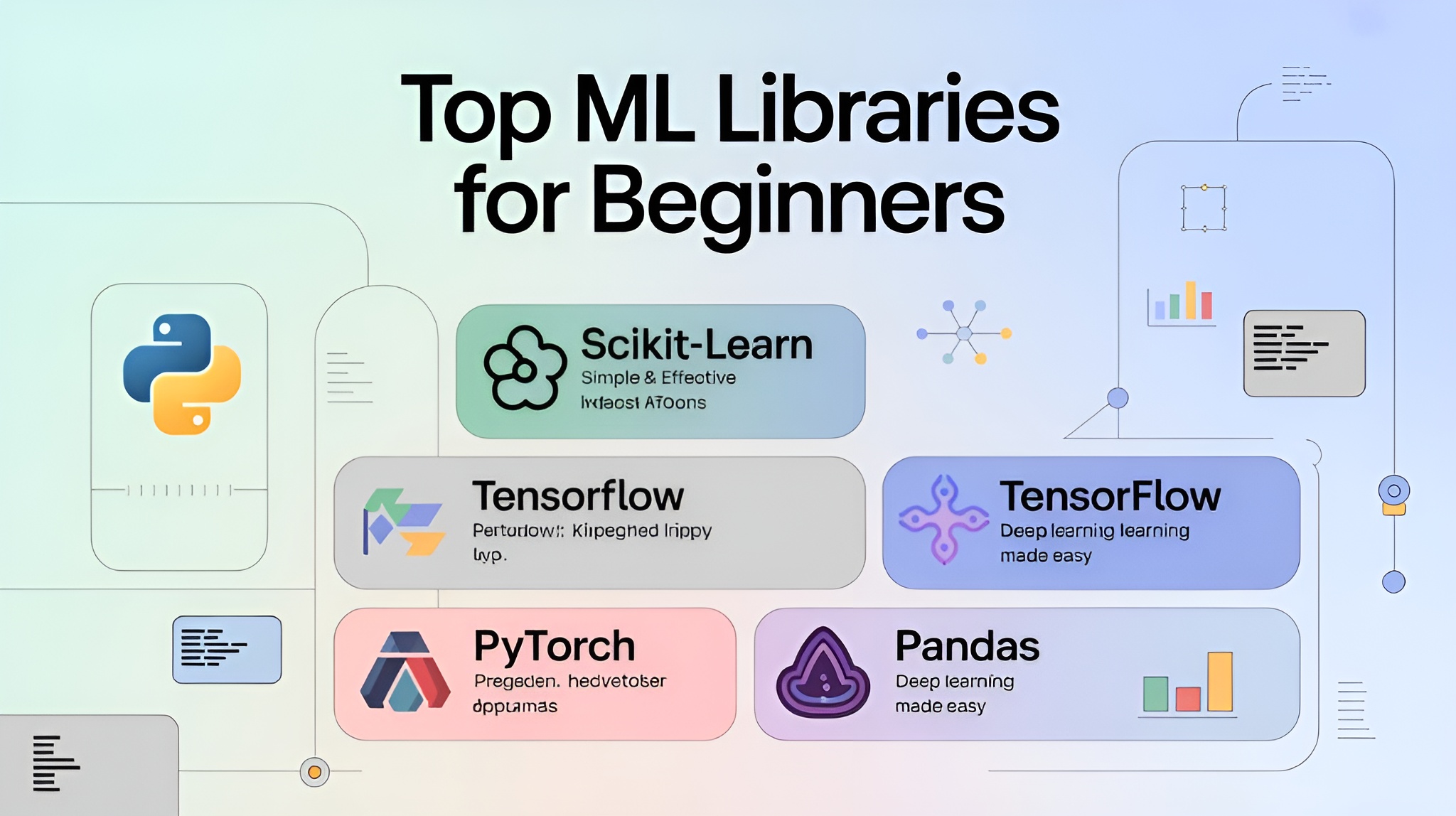
Table of Contents
“This guide introduces the most beginner-friendly machine learning libraries in 2026 and explains how each fits into a practical learning path. From data preparation and classic models to modern deep learning and AI applications, it helps new learners choose the right tools and start building real-world projects with confidence.”
Introduction
Machine learning can feel overwhelming at first. New terms, complex math, and powerful tools often make beginners believe they need years of experience before building anything useful. The reality is very different. Modern machine learning libraries are designed to handle the heavy lifting, allowing learners to focus on understanding data, experimenting with models, and solving real problems.
This guide introduces the most beginner-friendly machine learning libraries in 2026, explains what each one is best at, and shows how they fit into a simple learning path. Whether you are a student, developer, or curious professional, this article will help you move from curiosity to confidently building your first ML-powered projects.
What Beginners Should Look For in an ML Library
Before choosing a library, it helps to know what makes a tool beginner-friendly. Not all popular libraries are easy to learn, and not all easy libraries are useful in real-world projects. The best beginner tools balance simplicity with practical power.
Key things to consider include:
- Ease of installation: Libraries that install with a simple
pip installor Conda command reduce setup frustration. - Clear documentation: Good tutorials and examples make learning faster than trial and error.
- Strong community support: Active forums, videos, and GitHub repositories help when you get stuck.
- Low hardware requirements: Tools that run well on a regular laptop make learning more accessible.
- Real-world relevance: Libraries that can move from a notebook to a real application prepare you for practical use.
A Simple Machine Learning Workflow
All machine learning projects follow a similar structure, no matter which library you use. Understanding this flow helps you see where each tool fits.
- Collect or load data
- Clean and prepare the data
- Choose a model
- Train the model
- Evaluate its performance
- Improve and tune the model
- Deploy or use it in an application
Scikit-learn: Best for First Models
Scikit-learn is often the first stop for people learning machine learning. It provides simple, consistent tools for building classic ML models like classifiers and regressors.
What it’s used for
Scikit-learn is ideal for structured data problems such as predicting prices, classifying emails, or grouping customers.
Why beginners like it
The API is clean and predictable. Most models follow the same pattern: create the model, fit it to data, and make predictions. This consistency helps learners focus on concepts instead of syntax.
Beginner project ideas
- Spam email classifier
- Student performance predictor
- House price estimation model
When to move on
Once you want to work with images, audio, or very large datasets, you may need deep learning libraries like TensorFlow or PyTorch.
TensorFlow and Keras: Entry to Deep Learning
TensorFlow is a powerful framework for building neural networks, while Keras is its beginner-friendly interface. Together, they form one of the most popular deep learning ecosystems in the world.
What they’re used for
These tools are commonly used for computer vision, natural language processing, and large-scale AI systems.
Why they work for beginners
Keras allows you to define neural networks in just a few lines of code. Pretrained models and built-in datasets make it easy to experiment without building everything from scratch.
Beginner project ideas
- Handwritten digit recognizer
- Image classifier for plants or animals
- Simple chatbot
PyTorch: Learn How Models Really Work
PyTorch is a deep learning library known for its flexibility and Python-like design. It is widely used in research and by startups building custom AI systems.
What it’s used for
PyTorch excels at building and experimenting with neural networks, especially when you want fine control over how models are trained.
Why beginners choose it
The code feels intuitive, and debugging is easier compared to many other frameworks. This makes it great for learners who want to understand what happens inside a model.
Beginner project ideas
- Sentiment analysis on product reviews
- Neural network from scratch
- Image recognition system
Pandas and NumPy: The Hidden Foundation
While not machine learning libraries in the traditional sense, Pandas and NumPy are essential for almost every ML project.
What they handle
These tools are used for loading data, cleaning messy datasets, transforming features, and performing mathematical operations.
Why they matter
Most real-world ML problems fail or succeed based on data quality, not model choice. Pandas and NumPy help you understand and shape your data before training a model.
Beginner project ideas
- Dataset explorer dashboard
- Sales data analysis tool
- Data visualization report
Hugging Face Transformers: Modern AI Made Simple
Hugging Face provides access to powerful pretrained models for language and vision tasks. Instead of training massive models from scratch, beginners can use state-of-the-art AI with just a few lines of code.
What it’s used for
Text classification, translation, summarization, chatbots, and question-answering systems.
Why it’s beginner-friendly
The library offers ready-to-use pipelines that hide much of the complexity of deep learning.
Beginner project ideas
- AI-powered FAQ bot
- Social media sentiment analyzer
- Article summarizer
XGBoost and LightGBM: Real-World Business ML
These libraries focus on high-performance models for structured data and are widely used in industry competitions and business systems.
What they’re used for
Forecasting, risk analysis, recommendation systems, and financial modeling.
Why beginners should try them
They show how professional-grade machine learning systems are built and optimized for performance.
Beginner project ideas
- Customer churn predictor
- Loan approval model
- Sales forecasting system
Comparison Table
| Library | Best For | Difficulty | Example Projects | Hardware Needs |
|---|---|---|---|---|
| Scikit-learn | First ML models | Easy | Predictors, classifiers | CPU |
| TensorFlow/Keras | Deep learning | Medium | Vision, chatbots, NLP | CPU/GPU |
| PyTorch | Learning internals | Medium | Neural networks, experiments | CPU/GPU |
| Pandas/NumPy | Data preparation | Easy | Analysis, visualization | CPU |
| Hugging Face | Modern AI apps | Medium | Chatbots, summarizers | CPU/GPU |
| XGBoost/LightGBM | Business ML systems | Medium | Forecasting, risk models | CPU |
A Beginner Learning Roadmap
A simple and effective learning path looks like this:
- Learn basic Python programming
- Practice with NumPy and Pandas
- Build models using Scikit-learn
- Learn data visualization tools
- Choose TensorFlow or PyTorch for deep learning
- Explore Hugging Face for modern AI applications
Common Beginner Mistakes
Many learners slow their progress by making the same mistakes:
- Jumping into deep learning before understanding data
- Ignoring model evaluation and validation
- Focusing only on accuracy instead of real-world performance
- Training on messy or biased datasets
- Trying too many libraries at once instead of mastering one
Beginner-Friendly Project Ideas
If you want to turn learning into experience, try building:
- Student grade predictor
- Face mask or object detector
- Product recommendation system
- Fake news classifier
- Traffic sign recognition app
Free Learning Resources
To go further, explore these trusted platforms:
- Official documentation for each library
- Kaggle for datasets and beginner competitions
- Google Machine Learning Crash Course
- Fast.ai practical deep learning course
- MIT OpenCourseWare AI and ML materials
Conclusion
Machine learning libraries do not make someone an expert. Understanding data, asking the right questions, and solving meaningful problems do. The best approach for beginners is to choose one library, go deep, and build small projects that solve real needs.
In 2026, the barrier to entry for machine learning has never been lower. With the right tools and a clear learning path, anyone can move from beginner to builder and start creating intelligent systems that make a real impact.
Recommended Insights
Continue your journey